As AI tools take over knowledge searches, Naver turns shopping into its next gateway

Type “sofa” into Naver’s shopping app these days, and something different happens.
Instead of a grid of product listings, an AI agent asks questions. Do you live alone? Do you have pets? It notices browsing patterns suggesting a dog in the household and recommends waterproof fabrics and scratch-resistant materials. Then it proposes a specific product: a three-seat Aquatex sofa from Carrem Furniture, discounted 41 percent to 347,000 won ($235), rated 4.74 stars.

Ask it to compare brands, and it instantly generates a specification table.
This is Naver’s Shopping AI Agent 1.0 that launched in beta last week. On the surface, it looks like another AI feature. But it highlights a larger question playing out in one of the few markets where Google never fully took over: Can a local platform use its ecosystem to stay competitive in the age of generative search?
Search fades, growth holds
Globally, South Korea’s internet landscape has long been an anomaly. Naver’s search share once reached 78 percent in 2015. While that dominance has eroded, it remained strong at roughly 62 percent in 2025, according to government data.
When generative AI tools like ChatGPT emerged in late 2022, many analysts predicted the position would quickly weaken. Instead, Naver has continued posting record financial results — largely because search stopped being its core business years ago.
“Naver’s identity is search, but it hasn’t stayed there,” said Kim Do-yoon, an assistant professor of business at Yonsei University. Over the past decade, he said, the company has embedded itself into users’ daily routines through commerce, payments and content services.
The numbers reflect that transition. Naver reported record revenue of 12.04 trillion won ($8.76 billion) in 2025, up 12.1 percent year-on-year. Commerce revenue alone rose 26.2 percent to 3.69 trillion won.
“The biggest misconception is that falling search share automatically means falling ad revenue,” said Lee Ji-eun, a researcher at Daishin Securities. The decline, she noted, is concentrated in desktop informational search. “Mobile lifestyle searches — restaurants, shopping, local places — have held steady or even grown.”
Leading where search slows
Still, the search business is showing subtle warning signs.
OpenSurvey panel data from December shows Naver’s primary usage rate falling from 49.1 percent to 46.0 percent in nine months. The share of users ranking it among their top three search services dropped even faster, declining by 5.4 percentage points.
That pattern matters. “Users who turned to Naver as a second or third option are leaving faster,” Kim said, noting that a similar dynamic preceded Yahoo Japan’s long decline.
At the same time, generative AI services are spreading quickly. ChatGPT usage rose from 39.6 percent to 54.5 percent over the same period.
The category-level data is equally revealing. The fastest-growing search segments — knowledge acquisition and work-related queries — are precisely where AI tools are gaining traction. The areas where Naver remains dominant, including local places and shopping, are segments where search demand is relatively stable or declining.
In other words, Naver is strongest in parts of the search market that are no longer expanding.
That dynamic helps explain the company’s current strategy: doubling down on AI-driven commerce.
The local data edge
Naver’s commerce ecosystem is unusually deep.
Its Smart Store platform hosts more than 600,000 merchants. Naver Pay connects with 1.6 million online partners. Its Plus membership program further locks users into a network of cashback rewards and bundled services.
For domain-specific AI models, that data may matter more than model size. A Seoul National University researcher working on large language model agents, who requested anonymity, said that Naver’s direct access to transaction data from hundreds of thousands of merchants provides “a depth external players simply cannot reach.”
But the current system remains relatively basic.
Based on the beta version, the researcher said the AI shopping agent is “closer to rule-based curation with a natural-language interface layered on top” rather than a true agent.
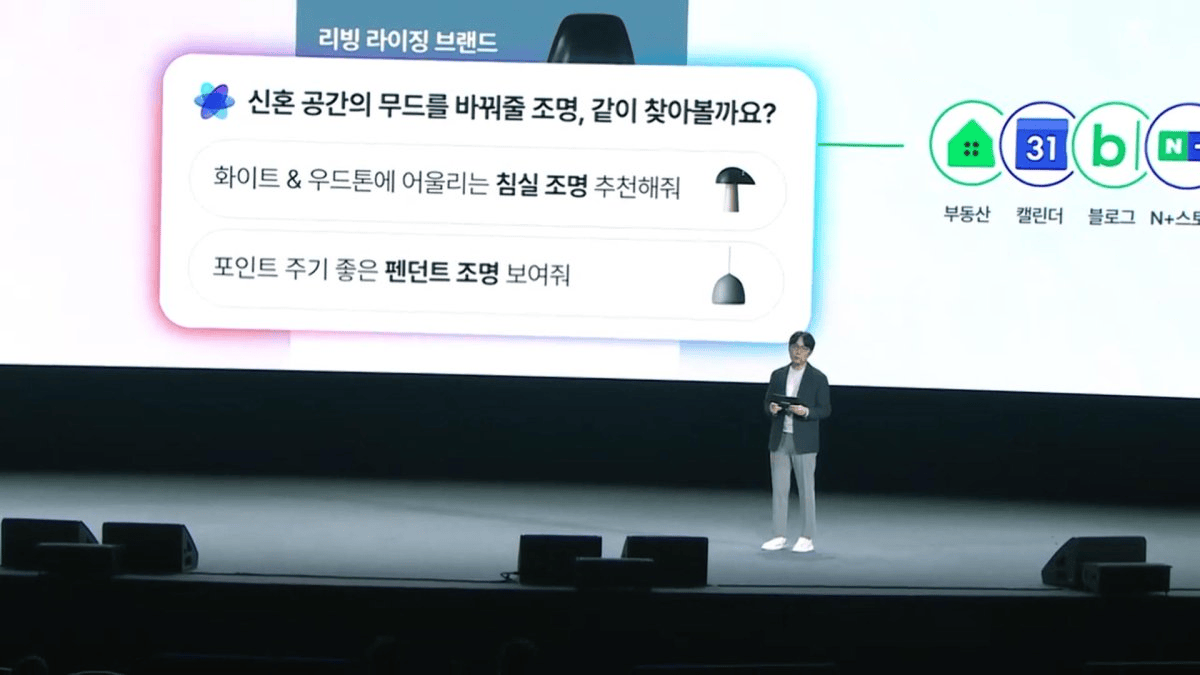
The real test will come later this year with the planned AI Tab, which aims to connect Naver’s various services — maps, local listings, shopping and payments — into a single conversational interface. "Technically, that would require coordinating multiple AI agents and data sources in real time for tens of millions of users," he said.
The agentic commerce race
Naver’s move reflects a broader shift toward AI-driven shopping agents. Google recently introduced its Universal Commerce Protocol with partners including Walmart, Target and Shopify, while OpenAI has begun integrating shopping features into ChatGPT.
Professor Kim argues Naver may hold a structural advantage. Unlike global AI companies that rely heavily on advertising, Naver already earns from payment commissions, transaction fees and memberships. Even if AI reduces ad clicks, higher purchase conversion could still lift overall commerce revenue.
For analysts, the key indicator is the revenue mix. Intermediation revenue is growing faster than commerce advertising, said Lee, signaling a shift from “a platform that shows ads” to “a platform where transactions actually happen.”
Still, Naver’s AI models are unlikely to rival those of Google or OpenAI. “HyperCLOVA X is far smaller than frontier models,” the SNU researcher said.
“What Naver has is two decades of localized data. The question is whether its AI can become good enough, fast enough to turn that advantage into the next generation of services.”
mjh@heraldcorp.com