Seoul plans joint excavation with Australia, remains exchange with US
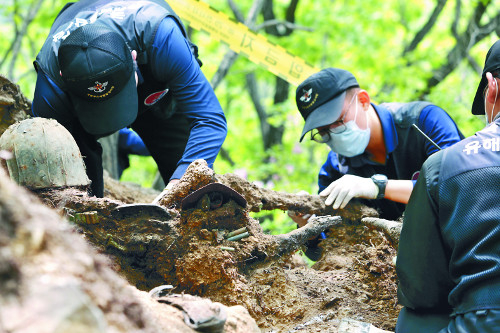
South Korea’s Defense Ministry said Monday it has launched this year’s recovery mission searching for the remains of soldiers who died during the 1950-53 Korean War.
According to the ministry, the project will be conducted in two phases, from March 9 to July 3 and from Sept. 1 to Nov. 27, with a preparation period in between.
A total of 31 military units, including 30 Army units and the Marine Corps’ 1st Division, will participate in the project, with more than 100,000 troops participating cumulatively.
The ministry said it aims to recover about 200 sets of remains this year, a roughly 42 percent increase from the 141 sets recovered last year.
Excavation will take place at 34 sites across 22 cities and counties nationwide, many of which were major battlegrounds during the Korean War, including areas in Paju and Yeoncheon in Gyeonggi Province, as well as Inje and Cheorwon in Gangwon Province.
As part of the effort, the ministry will also conduct a joint excavation project with Australia to recover the remains of Australian soldiers who went missing during the Battle of Kapyong in the war. The joint recovery operation is scheduled for April.
Separately, the ministry is coordinating with the US Department of Defense to exchange remains of war dead. Under the arrangement, the two sides return the remains of their respective soldiers discovered in each country.
“The ministry aims to hold a joint repatriation ceremony for the remains of Korean and US service members within this year,” the ministry said.
The ministry has secured more than 120,000 DNA samples from family members of the war dead. Converted by the number of missing soldiers, the samples correspond to family members of about 76,400 service members — around 57 percent of the 133,711 troops who remain unaccounted for as of March 5.
After collecting 10,301 new samples last year, the ministry said it aims to secure another 10,000 samples this year and identify the remains of more than 20 soldiers.
Since 2021, the remains recovery agency has identified and returned the remains of more than 20 fallen service members to their families each year.
“The mountains and fields across the country where excavation work is taking place are sites where South Korea fulfills its commitment to take responsibility for the heroes who sacrificed their lives for the nation,” said Lt. Col. Kim Sung-hwan, acting head of the Defense Ministry’s remains recovery agency.
“We will make every effort to identify the remains as soon as possible and return them to their families,” Kim added.
flylikekite@heraldcorp.com