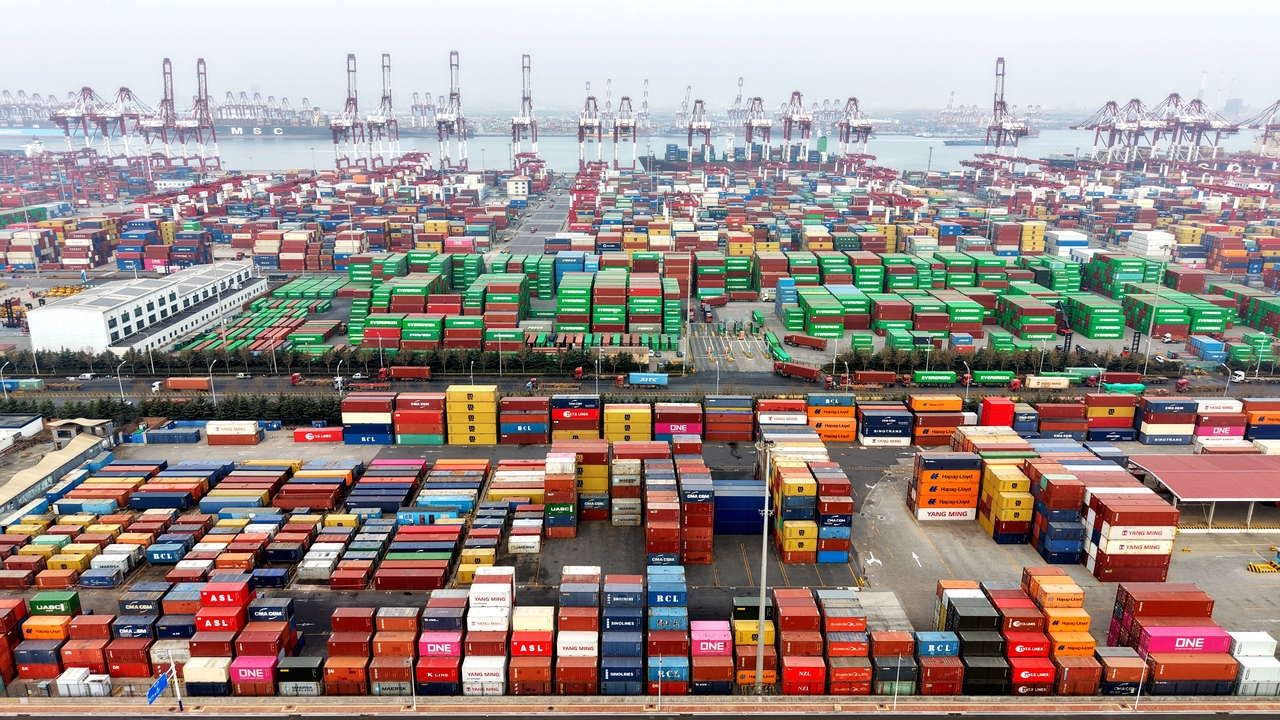
BEIJING (Reuters) -- China roared into 2026 with exports far outstripping forecasts, fueled by red-hot electronics demand, putting the economy on track to top last year's record $1.2 trillion trade surplus and blunting the blow from the war in Iran.
Outbound shipments from the world's second-largest economy grew 21.8 percent in US dollar terms in the January-February period, sharply up from the 6.6 percent increase recorded in December and blowing past the median forecast in a Reuters poll of 7.1 percent growth.
"The strength in integrated circuits and technology exports is well expected, in line with the artificial intelligence investment boom," said Xu Tianchen, senior economist at the Economist Intelligence Unit.
"Growth in clothing, textiles and bags exports was surprising, given their poor performance in 2025 amid challenges from Southeast Asia and South Asia," he added.
China's export momentum could accelerate in the months ahead, Xu said, with March data likely to show factories rushing shipments to the US to exploit the Supreme Court's tariff reprieve and Chinese firms muscling back into low value-added sectors like textiles.
China's trade surplus for the first two months came in at $213.6 billion, the data showed, far exceeding the $169.21 billion recorded in the same period last year. Economists had forecast a trade gap of $179.6 billion in the poll.
Commerce Minister Wang Wentao on Friday hinted that the numbers would be "better than expected" during a press conference on the sidelines of China's annual parliamentary meeting.
"Globally, major Western economies have entered a phase of fiscal expansion," said Dan Wang, director for China at Eurasia Group. She added that there is also big demand for China's 'New Three': electric vehicles, lithium-ion batteries and solar cells.
For now, nothing suggests China's export dominance will slow in the months ahead.
US President Donald Trump's renewed 2025 tariff war barely dented China's industrial momentum, with manufacturers redirecting their exports to Southeast Asia, Africa and Latin America to blunt the impact of losing US demand.
More governments are now weighing trade restrictions similar to Washington's, worried that China's industrial overcapacity and deflation are pushing excess goods into global markets and threatening their own manufacturing sectors.
Premier Li Qiang announced last week that China would seek an economic growth target of 4.5 percent-5 percent for 2026, down from last year's 5 percent, which was met largely through a one-fifth surge in its trade surplus.
Although policymakers pledged a "notable" increase in household consumption in the government's next five-year plan, economists are skeptical that Beijing will move away from its reliance on exports any time soon, as the strategy document offered few specifics to bolster expectations for robust demand-side reform.
China's imports increased 19.8 percent in January-February, well above the 5.7 percent gain in December.
Factory activity data for February released last week showed Chinese firms still struggling to turn a profit at home, even as overseas orders improved, underscoring the continued appeal of exports for policymakers and producers.
Trump is expected to visit Beijing later this month for a highly anticipated leaders' summit, but hopes for a meaningful truce between the two superpowers remain low, with both sides appearing ready to resume their trade war if necessary.