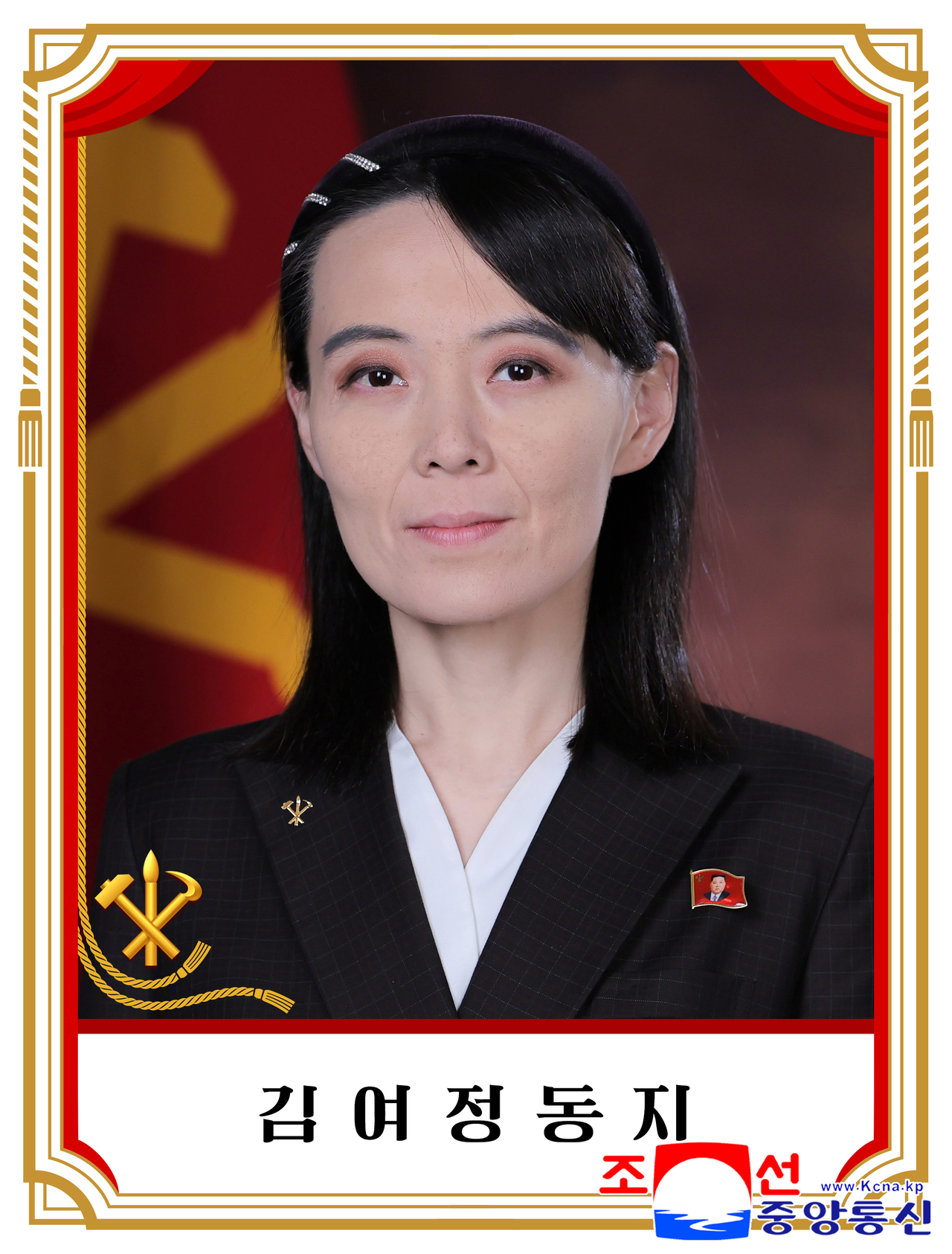
Kim Yo-jong, the powerful sister of North Korean leader Kim Jong-un, warned Tuesday that joint military exercises between South Korea and the United States could lead to “unimaginably terrible consequences,” as the allies began their annual spring drills on the Korean Peninsula.
Kim, a department director in the ruling Workers' Party of Korea, issued the warning in a statement carried by the state-run Korean Central News Agency a day after South Korea and the US launched their annual joint exercise, known as Freedom Shield. Running for 11 days, the exercise includes computer-simulated command post drills and field training designed to prepare for wartime scenarios.
“The muscle-flexing of the hostile forces near the areas of our state's sovereignty and security may cause unimaginably terrible consequences,” Kim said in the statement carried by the Korean Central News Agency.
She said the drills were taking place “at a critical time when global security structure is collapsing rapidly and wars break out in different parts of the world due to the reckless acts of the outrageous international rogues.”
“This will result in further destroying the stability of the region,” she noted.
North Korea routinely condemns the annual exercises, which Washington and Seoul say are defensive in nature. Pyongyang, however, views them as rehearsals for invasion.
In her statement, Kim accused the allies of maintaining an entrenched hostile stance toward Pyongyang, describing the drills as a “provocative and aggressive war rehearsal of those simulating and planning the confrontation” with the North.
Referring to what she called “recent global geopolitical crisis and complicated international events,” she argued that modern military conflicts blur the line between training exercises and real combat operations. While she did not specify the events she was referring to, analysts said the remarks appeared to allude to the broader geopolitical tensions triggered by recent military confrontation involving Iran, Israel and the US.
“They should be suppressed through an extraordinarily overwhelming and preemptive super-offensive,” Kim noted.
“Our head of state has already clarified that it is undoubtedly a law and iron principle that the most powerful offensive capability constitutes the most reliable deterrent,” Kim also noted. “The enemies should never try to test our patience, will and capability.”
Still, officials and analysts in South Korea suggested that Pyongyang’s rhetoric was relatively restrained compared to past reactions to joint military drills.
An official at the Ministry of Unification said the statement avoided directly naming the US or invoking North Korea’s nuclear arsenal, suggesting the North may have moderated its tone.
“Kim Yo-jong appears to have limited her response to merely pinpointing the South Korea-US exercise, taking the current security situation into account,” the official said on condition of anonymity.
“Although the statement contains threatening language, it does not directly refer to the US and does not mention North Korea’s nuclear forces,” the official said.
The official reiterated Seoul’s position that stability on the Korean Peninsula benefits both sides.
“Peace and stability on the Korean Peninsula are important for both the South and the North and are essential conditions for sustained development and stability,” the official said. “Our government will continue to pursue efforts to achieve peaceful coexistence on the Korean Peninsula in a calm and consistent manner.”
For now, analysts say, Pyongyang appears to be balancing familiar warnings with a more measured tone, leaving open the possibility of future negotiations with Washington even as tensions persist.
Hong Min, a senior researcher at the Korea Institute for National Unification also noticed the absence of direct references to the US or US President Donald Trump, echoing the Unification Ministry. He suggested that North Korea was deliberately moderating its rhetoric.
Instead of naming Washington directly, the statement referred more broadly to “enemies,” a pattern Hong pointed out Pyongyang has increasingly adopted since the second half of last year.
But Hong said North Korea could still respond militarily if US strategic assets are deployed to the Korean Peninsula during the drills, potentially through its usual ballistic missile launches.
Lim Eul-chul, professor at the Institute for Far Eastern Studies at Kyungnam University said North Korea could seek to demonstrate the "unimaginably terrible consequences" mentioned in the statement by testing new weapons systems, such as a new intercontinental ballistic missile known as the Hwasong-20 or advanced rocket artillery known as the KN-23.
About 18,000 troops are expected to take part in this year’s Freedom Shield exercise, a scale similar to last year’s drills. The allies plan to carry out 22 field training exercises during the operation, roughly half the number conducted in last year’s program.
Tuesday’s statement also marked Kim Yo-jong’s first public remarks toward South Korea since she was promoted to director of the ruling party’s general affairs department during the Workers’ Party congress last month. She previously served as a vice department director.
mkjung@heraldcorp.com