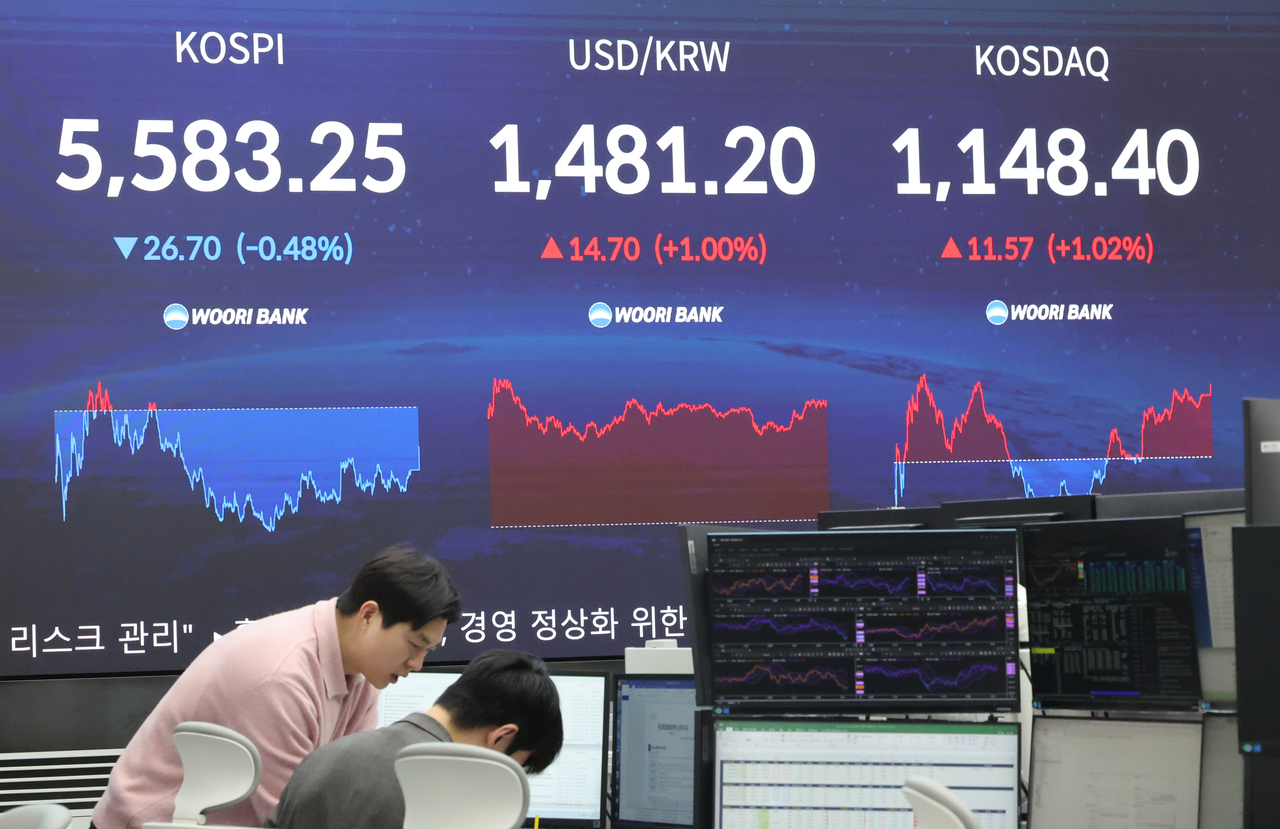
South Korean stocks closed lower Thursday amid escalating tensions in the Strait of Hormuz, which triggered extreme volatility in global oil prices. The local currency fell sharply against the greenback.
The Korea Composite Stock Price Index moved down 26.7 points, or 0.48 percent, to close at 5,583.25.
Trade volume was heavy at 794.1 billion shares worth 23.6 trillion won ($15.9 billion), with gainers outpacing losers 569 to 321.
Foreigners sold a net 2.36 trillion won while individuals bought a net 2.23 trillion won. Institutions bought a net 53.9 billion won.
Tensions continued to persist around the critical waterway south of Iran despite US President Donald Trump's claim that the war is nearing an end, with attacks on commercial ships reported.
The International Energy Agency announced a plan to release oil reserves to address fluctuations in global oil prices, but investors stayed on the sidelines amid concerns the conflict could linger for a longer period.
"Global crude prices have surpassed $90 (per barrel) again, with the stock market reflecting such tensions," said Lee Kyoung-min, a researcher at Daishin Securities.
Lee, however, noted the South Korean stock market appears to be experiencing eased volatility after recent swings.
"(Seoul shares) have become less sensitive to geopolitical risks," Lee added.
Top tech giant Samsung Electronics lost 1.11 percent to 187,900 won, and SK hynix slipped 2.62 percent to 930,000 won.
Foodstuff maker Nongshim lost 5.08 percent to 374,000 won after local brokerage houses revised down the firm's target stock price.
Leading oil refiner SK Innovation moved up 1.84 percent to 121,700 won, and S-Oil advanced 2.97 percent to 118,000 won.
Mirae Asset Securities fell 1.4 percent to 70,400 won, while Kiwoom Securities closed unchanged at 450,000 won.
The Korean won was trading at 1,481.2 won against the US dollar, down 14.7 won from the previous session, as of 3:30 p.m.
Bond prices, which move inversely to yields, closed lower. The yield on three-year Treasurys added 1.8 basis points to 3.271 percent, and the return on the benchmark five-year government bonds rose 2.6 basis points to 3.496 percent. (Yonhap)