South Korea's political arena is once again facing an "apology trap," where rival parties and factions take issue with the sincerity of an apology for political events.
On Monday, the conservative opposition People Power Party adopted a resolution apologizing for former President Yoon Suk Yeol's declaration of martial law, after months of internal discord and indecision.
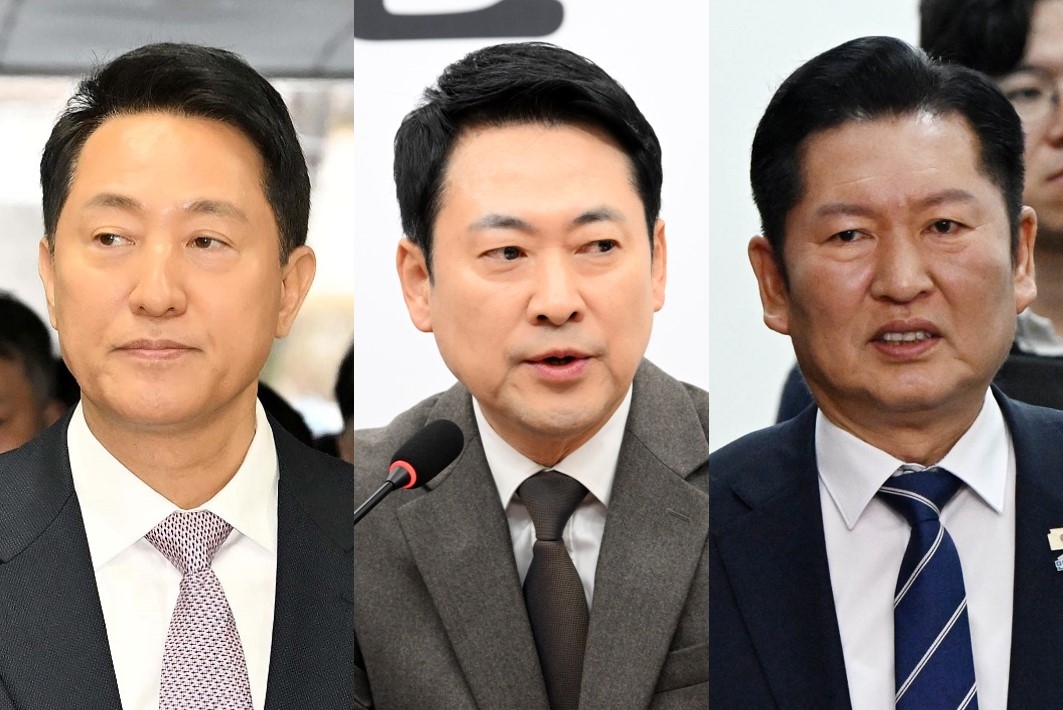
The party's on-the-fence position on Yoon and his supporters was most notable in the actions of party chair Rep. Jang Dong-hyeok.
In February, Jang stated that the party took responsibility for developments surrounding the martial law fiasco, but a month later he refused to cut ties with Yoon supporters the day after Yoon was sentenced to life in prison for leading an insurrection.
Jang's move in February prompted conservative Seoul Mayor Oh Se-hoon to decide not to register his candidacy with his party before the Sunday deadline.
The move by Oh -- the conservatives' strongest potential contender in the Seoul mayoral race on June 3 -- prompted the party to adopt the resolution on Monday.
Calls for another apology come from both sides of the aisle, but People Power Party chair Rep. Jang Dong-hyeok's recent remarks hint that a second apology is unlikely.
Ruling Democratic Party chair Rep. Jung Chung-rae is pressing the opposition to apologize again, alleging a lack of sincerity in the first statement.
"Dear People Power Party, your apology this time was wrong. We hope you will apologize again. The people are waiting for it," Jung said on Wednesday, adding that the party seemed to have been nudged into an insincere apology as the election drew closer.
Some conservative politicians echoed that sentiment.
Rep. Cho Kyoung-tae, a six-term lawmaker of the People Power Party, said his party's apology should involve more than words.
"An apology from the party without action will only feed public distrust," Cho said Wednesday, adding that all People Power Party lawmakers should gather and bow in apology on the back lawn of the National Assembly, where helicopters carrying armed soldiers landed when Yoon's martial law decree was in effect. He also called for the expulsion from the party of Yoon sympathizers like history lecturer-turned-YouTuber Jeon Han-gil.
Seoul Mayor Oh also said in a Facebook post Wednesday that the apology "should be more than just a statement," adding that the people are waiting for "tangible changes" in the party.
Despite continuing friction in and out of the party, Jang on Wednesday said that Monday's resolution "would be our final statement" regarding the party's relationship with Yoon. Oh again told reporters on Thursday he would not register by the extended deadline and would continue to consult with the party over his candidacy.
As for public sentiment, Monday's apology appears to have had little impact.
According to Thursday's National Barometer Survey conducted jointly by Mbrain Public, Kstat Research, Korea Research and Hankook Research, the People Power Party's support rating remained unchanged from the previous poll at 17 percent, whereas that of the Democratic Party slid 2 percentage points to 43 percent.
This prompted observations that the party appears mired in an apology trap.
"Ironically, an apology is a way to eliminate the rationale for fighting against our opponents, because our side feels powerless while our opponent gains momentum and demands more," said Park Min-young, media spokesperson of the People Power Party, on Thursday.
"An apology itself is not necessarily bad, but we should avoid being pushed into apologizing by our opponent," he added.
An observer, however, said there is room for the opposition party's apology to become more sincere.
Eom Ki-hong, professor of political science at Kyungpook National University, recalled former President Park Geun-hye's decision in 2004 to use a makeshift hut back when she chaired the main conservative Grand National Party, instead of an existing office used as the party's headquarters.
Her show of determination to overcome the party's corruption scandal bore fruit, as the party won the general election against the then-ruling liberal party the same year.
"Other than staunch supporters of the People Power Party, many people will still doubt whether the party has fully apologized as no concrete actions have been taken alongside the gestures of apology so far," Eom said.
"Back when Park moved out of the party headquarters and used a makeshift hut, she did so on her own," Park of the People Power Party said. "She was not forced to do so by her political opponent."
consnow@heraldcorp.com