The government said Thursday it will implement a temporary fuel price cap system this week to help ease cost burdens amid supply concerns over the ongoing Middle East crisis, officials said Thursday.
The government announced the plan at a task force meeting of ministers in charge of managing market prices, as domestic fuel prices have fluctuated since the United States and Israel launched airstrikes against Iran late last month.
It marks the first time since 1997 that South Korea is enforcing the price ceiling system using a provision in the Petroleum Business Act that allows the industry minister to designate a maximum sales price when oil prices fluctuate sharply and threaten economic stability.
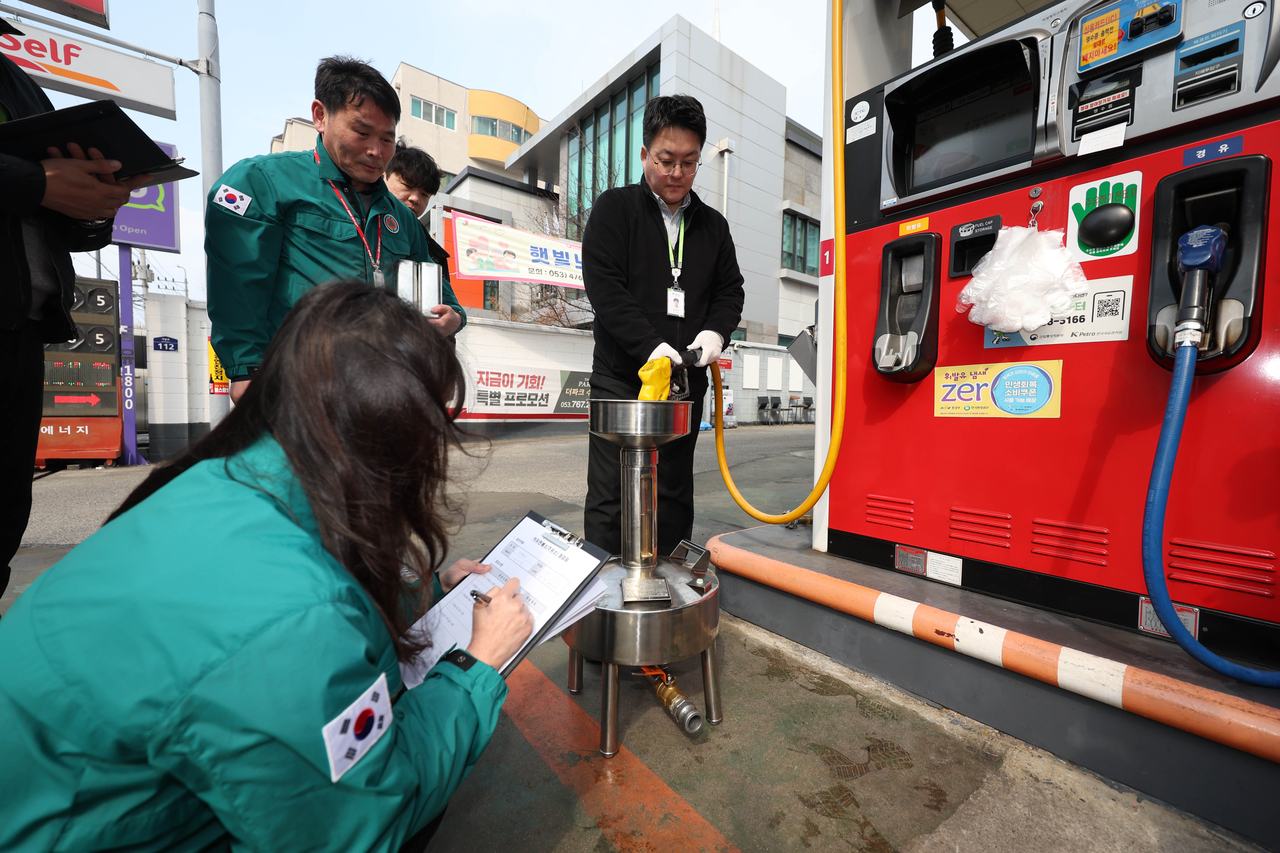
Under the price cap system, the government will set maximum prices for oil products South Korean oil refineries supply to gas stations and distributors, according to the Ministry of Trade, Industry and Resources.
The maximum price will be calculated by multiplying the weekly average supply prices of regular gasoline, diesel and lamp oil products, and the adjustment rate of the Mean of Platts Singapore (MOPS), added with related taxes. MOPS is a benchmark price for petroleum products across the Asia-Pacific region.
The initial price cap will be set based on the supply prices of fuel products before the outbreak of the Middle East crisis, with the threshold to be readjusted every two weeks to reflect changes in international oil prices, the officials explained, noting the terms may change if and when necessary.
The envisioned price cap system comes amid surging fuel prices sparked by the prolonging crisis in the Middle East.
Gasoline prices here increased by at least 200 won ($0.14) per liter and diesel prices by a minimum of 300 won per liter since the Middle East turmoil that broke out on February 28, according to the ministry.
The price cap system is expected to stabilize the average retail price of gasoline to below the 1,830 won level, diesel prices to below the 1,930 won level and lamp oil prices to below the 1,730 won level, Yang Ghi-wuk, deputy minister for trade, industry and resource security, said.
The average gasoline price nationwide stood at 1,904.3 won per liter as of Wednesday, up from 1,692.6 won on Feb. 27, a day before US and Israeli initiated airstrikes against Iran, according to data compiled by the Korea National Oil Corp.
The average diesel price rose to 1,927.5 won from 1,597.2 won over the cited period.
Additionally, the government will impose export restrictions on fuel products that come under the price cap system to prevent the excessive export of petroleum products possible due to the price gap between domestic and foreign markets.
Regarding financial losses oil refineries may suffer due to the system, the government plans to compensate the losses after the program is finished.
The government plans to lift the price ceiling when domestic fuel prices stabilize, Yang said.
On top of the price control scheme, the government said it will continue stern responses to unfair market practices involving fuel products, including hoarding and price gouging. (Yonhap)