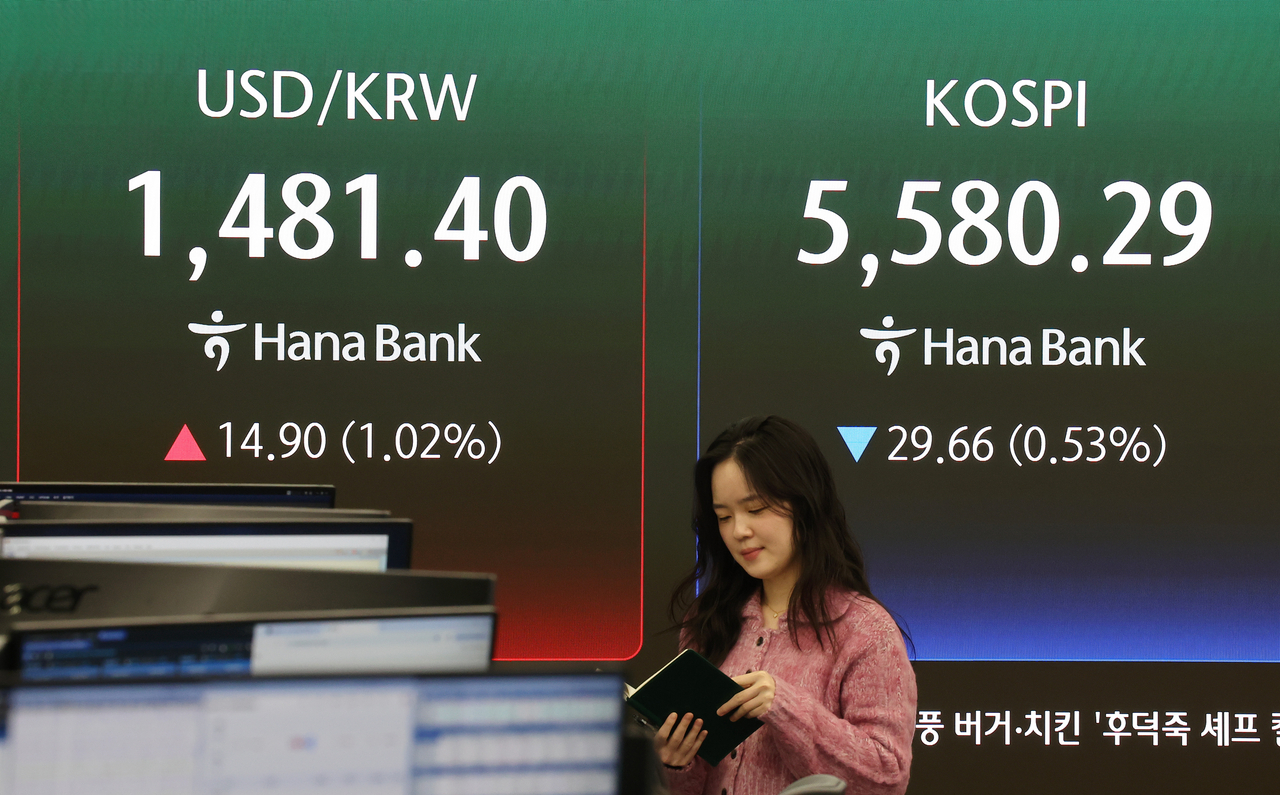
Foreign investors pulled a record amount of funds from South Korea’s stock market last month as they locked in profits following a rally, central bank data showed Thursday.
According to a report on international finance and foreign exchange markets released by the Bank of Korea, foreign investors sold $7.76 billion more Korean securities than they bought in February.
The February figure marked the second-largest net outflow on record and ended a five-month streak of net inflows that had continued since September last year.
By asset class, equities accounted for the bulk of the outflows, with $13.5 billion leaving the Korean stock market — the largest monthly outflow on record.
In contrast, bond investments recorded net inflows of $5.74 billion, partially offsetting the equity sell-off.
The central bank attributed the sharp equity outflow mainly to profit-taking after a rise in Korean stock prices, along with growing caution over investments tied to artificial intelligence.
“Stock funds saw a large net outflow due to profit-taking following domestic stock market gains and concerns related to AI investments,” the Bank of Korea said.
Meanwhile, demand for bonds remained strong, supported by bargain-hunting amid rising market interest rates and increased investment from private-sector investors, the bank added.
Market volatility also increased during the month. The credit default swap premium on Korea’s sovereign bonds, a gauge of perceived credit risk, rose to an average of 22 basis points, up slightly from 21 basis points the previous month.
The won-dollar exchange rate also became more volatile. The average daily fluctuation widened to 8.4 won, with a daily volatility rate of 0.58 percent, compared with 6.6 won and 0.45 percent in January.
By Herald Business reporter Kim Beo-ri (kimstar@heraldcorp.com)
Edited by Korea Herald Business Desk Editor Lee Ji-yoon (jylee@heraldcorp.com)
The original Korean version of this story is available at:
jylee@heraldcorp.com