South Korea has called for ensuring that the US investigation into 16 economies to uncover "unfair" trade practices does not negatively affect the implementation of commitments outlined in the ROK-US Joint Fact Sheet, a Foreign Ministry official said Thursday.
The remarks addressed the Office of the US Trade Representative's latest move to launch a Section 301 investigation under the 1974 Trade Act into South Korea, China, Japan and 13 other economies to examine alleged unfair trade practices linked to structural overcapacity and production.
“We cannot help but be concerned about the Section 301 probe, so we said the direction and process of the investigation should be managed carefully so that it does not have a negative impact on the Joint Fact Sheet,” the official told reporters on condition of anonymity.
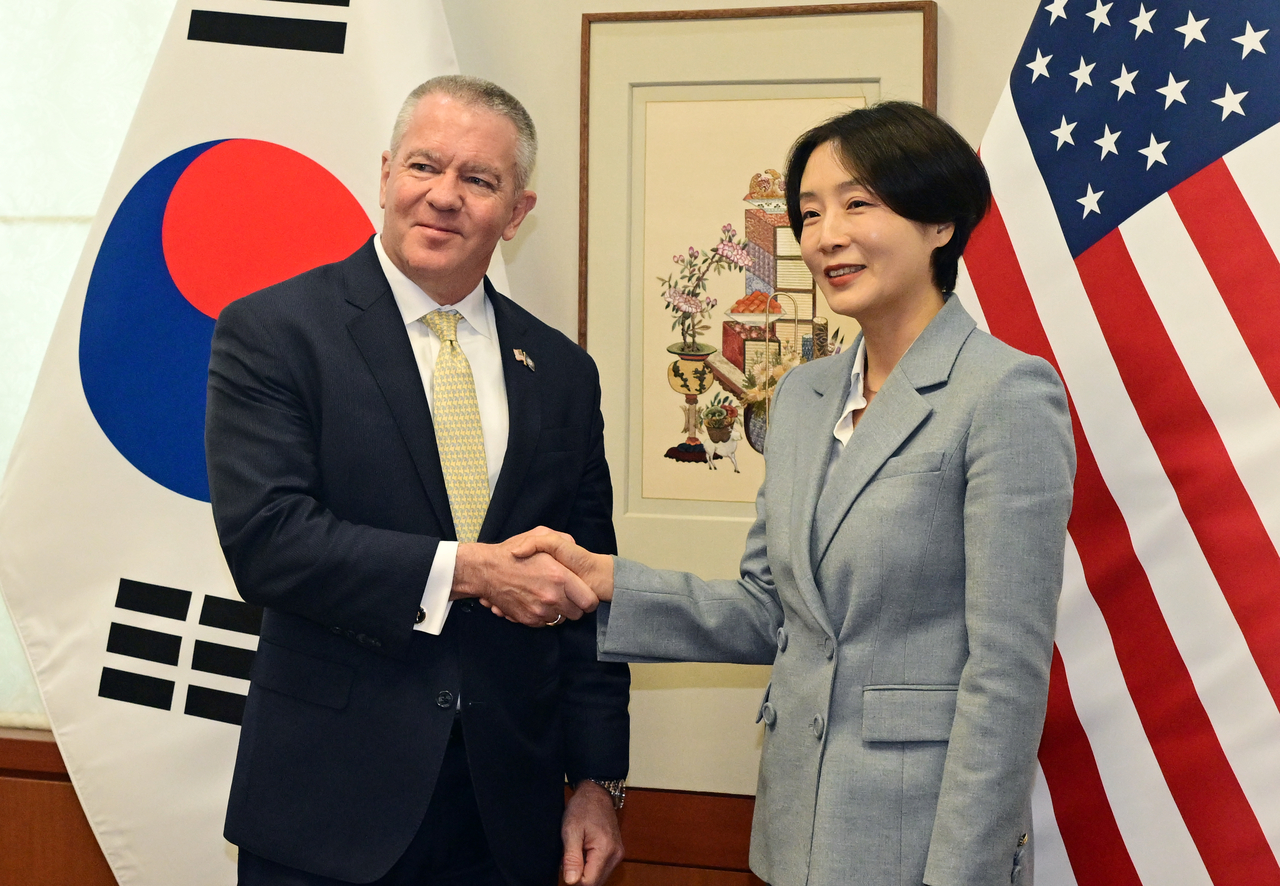
The remarks followed First Vice Foreign Minister Chung Eui-hae's luncheon meeting and talks with Michael DeSombre, US assistant secretary of state for East Asian and Pacific affairs, who is visiting Seoul. DeSombre also met with Jeong Yeon-doo, vice minister for diplomatic strategy and intelligence overseeing North Korea issues, and Park Jong-han, deputy foreign minister for economic affairs.
According to the official, Chung explained developments related to the passage of the special act on strategic investment in the US, and called on DeSombre to play an active role in ensuring that agreements in the security sector, including nuclear energy cooperation and the introduction of nuclear-powered submarines, produce tangible results as soon as possible.
DeSombre expressed agreement, saying Washington would work to advance consultations in the security field.
Economic issues were featured prominently in the talks, according to the ministry official. DeSombre described the South Korean National Assembly’s passage of the investment bill on Thursday as a “positive development” and expressed hope that follow-up measures would not be delayed, the official said.
The Assembly passed a special bill to implement Seoul’s $350 billion investment pledge to the US, part of a bilateral trade agreement reached last year.
The bill calls for the creation of a state-run corporation to manage the investment package, including the establishment of a strategic investment fund, as Washington has pressed Seoul to move forward with the commitments outlined in the ROK-US Joint Fact Sheet. The joint fact sheet was agreed following a summit between President Lee Jae Myung and US President Donald Trump in November last year.
Chung and DeSombre also discussed the need to monitor the possibility of tariff increases.
“We need to monitor the situation,” the official said, adding that Seoul conveyed its position that it hopes tariffs will not rise above the levels previously agreed upon and that the two countries will maintain a mutually beneficial trade arrangement.
Seoul's Foreign Ministry said ways to implement agreements outlined in the joint fact sheet, bilateral relations, and regional and global developments were discussed in the meeting between Chung and DeSombre.
Chung explained recent progress in implementing investment agreements between the two countries, including developments related to the National Assembly's passage of South Korea’s special act on strategic investment in the US, the ministry said in a statement. She also called for DeSombre’s active engagement to ensure that security-related agreements under the joint face sheet yield tangible results as soon as possible.
During DeSombre's meeting with Jeong, the two sides exchanged views on developments related to the Korean Peninsula, including North Korea’s activities following the Ninth Congress of the ruling Workers’ Party of Korea, according to the Foreign Ministry. Both sides reaffirmed the importance of close coordination between Seoul and Washington to maintain peace and stability on the Korean Peninsula and agreed to continue strengthening communication through various bilateral channels.
The discussions came as Trump is set to visit Beijing from March 31 to April 2, raising speculation that the trip could create an opportunity to revive US-North Korea talks.
Washington has also been pushing for “alliance modernization,” which envisions greater strategic flexibility for US troops and assets stationed on the Korean Peninsula, and this was expected to be another key topic during the discussions.
Recent reports suggested that some US missile defense assets stationed in South Korea, including components of the THAAD missile defense system, may have been redeployed to the Middle East amid heightened tensions involving Iran. South Korean military authorities have neither confirmed nor denied such movements, citing operational security.
During a stop in Tokyo earlier this week, DeSombre met Japanese officials and welcomed Japan’s investments in the US, deeper cooperation on critical minerals and a new shipbuilding partnership, according to the US State Department.
The diplomatic push also comes amid broader economic tensions, as the Trump administration opened a Section 301 trade investigation into South Korea, Japan, China and several other economies.
On Friday, DeSombre will join Vice Minister of Patriots and Veterans Affairs Kang Yun-jin in visiting a newly built memorial at the War Memorial of Korea in Yongsan-gu, Seoul, honoring US Forces Korea service members who died or went missing after the 1953 Korean War Armistice Agreement, according to the Veterans Ministry.
The ceremony, hosted by the ROK-US Alliance Foundation — a nonprofit organization dedicated to strengthening the alliance by honoring veterans’ sacrifices, promoting security cooperation and fostering future generations — is expected to underscore the enduring security partnership between Seoul and Washington.
DeSombre arrived in South Korea on Wednesday after visiting Japan as part of a March 9-17 tour of Japan, South Korea and Mongolia, and is scheduled to remain in the country until Sunday.
mkjung@heraldcorp.com